Discount for cash · Australia wide
Discount for cash for laundromats and 24-hour sites
Card surcharges are being removed from 1 October 2026. The Reserve Bank of Australia says discounts for particular payment methods can continue — so a discount for cash is now the main pricing lever laundromats and 24-hour sites have. Here is how to price it, display it, and make cash available on site.
Most enquiries receive a response within 3 hours during business hours.
Short answer
Can laundromats and 24-hour sites offer a discount for cash?
Yes. The Reserve Bank of Australia states businesses can continue to offer discounts for particular payment methods, and that removing its prohibition on no-surcharge rules is not intended to prevent discounts being offered to consumers for using certain payment methods — the RBA names discounts as a way to steer customers instead of using surcharges. Card surcharging itself is being removed from 1 October 2026, so for laundromats and 24-hour sites a discount for cash is the pricing lever that remains.
Sources: Reserve Bank of Australia, Removal of Payment Surcharges From 1 October 2026 — Frequently Asked Questions, Review of Merchant Card Payment Costs and Surcharging — Conclusions Paper, Chapter 2 and Media Release 2026-10. Reviewed 9 September 2026.
Discount for cash · or sign
What it means for your venue
A discount for cash is now the main pricing lever a venue has. It only changes behaviour if customers can get cash on site, so pair the offer with an ATM in line of sight of the counter and clear signage at the point of decision — including laundromats and 24-hour sites.
Government / official source: Reserve Bank of Australia
General information only, summarised from the official source above on 9 September 2026. Not financial, legal or taxation advice — verify the detail with the source document before acting.
Definitions
The three terms that matter
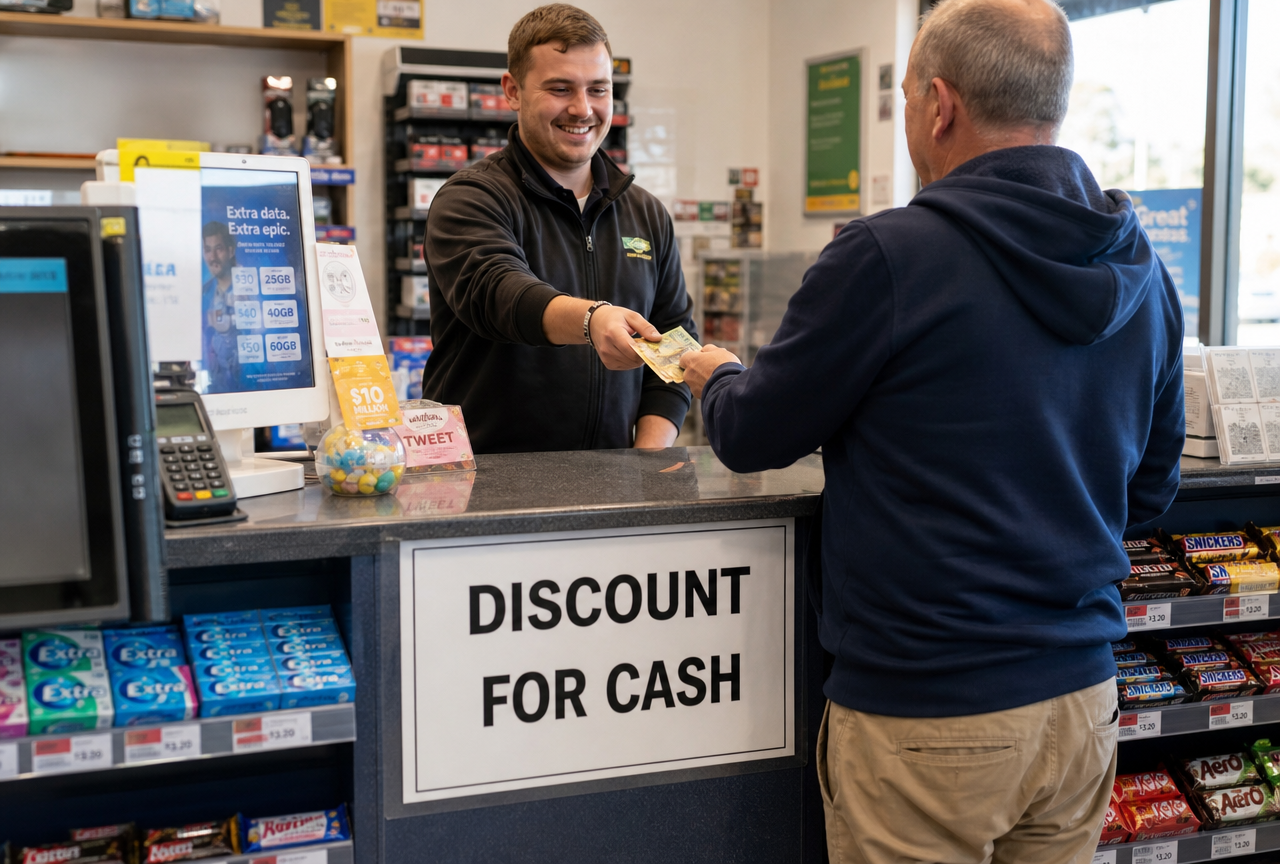
A cash discount is a reduction from a business's normal displayed price that applies only when the customer pays with notes and coins. The displayed price stays the price everyone pays and the cash price sits below it. A sign reading "20c off when you pay cash" is a cash discount.
A card surcharge is an extra amount added on top of the displayed price when a customer pays by card. It is the same economics in the opposite direction, and it is the one being removed as the card networks introduce no-surcharge rules from 1 October 2026.
Cost of acceptance is the total cost a business pays to accept a payment. It includes scheme fees, interchange, the provider's margin, terminal rental and any minimum monthly charge. Cost of acceptance is the number a cash discount must be priced against, because it is the cost a cash sale avoids.
This trade
Why the change bites hardest in laundromats and 24-hour sites
Unattended and 24-hour sites need cash to function at all in many cases, and customers arriving without notes simply leave, so on-site cash is revenue protection.
The moments below are where the decision actually happens in laundromats and 24-hour sites. Put the offer in front of the customer at those points, not on a poster near the door where nobody reads it.
Where the decision happens
- Overnight washes
- Weekend bulk laundry
- Vending and top-up purchases
- Unattended after-hours trade
Sites we place ATMs in
- Laundromats
- Car washes
- Vending sites
- 24-hour convenience sites
Compare
Cash discount versus card surcharge
Same arithmetic, opposite direction — and only one of them survives 1 October 2026.
| Point of difference | Cash discount | Card surcharge |
|---|---|---|
| How the price moves | Reduces the displayed price for cash payments | Adds an amount on top of the displayed price for card payments |
| Status from 1 October 2026 | Can continue to be offered, per the RBA | Removed as card networks introduce no-surcharge rules |
| How the customer reads it | A reward for choosing cash | A penalty for using a card |
| What it needs to work | Clear signage and cash available on site | Terminal functionality the provider may now switch off |
| Effect on your fees | Fewer card sales, so fewer per-sale fees | Recovers the fee rather than reducing it |
| Typical shape for laundromats and 24-hour sites | A flat cents-per-sale discount on small baskets | Previously a percentage capped at cost of acceptance |
How to
How to set up a discount for cash in laundromats and 24-hour sites
Five steps, priced from your own statement rather than a headline rate.
- 1
Work out your real cost per card sale
Divide the total card fees on your last merchant statement by the number of card transactions in the same period. That is the cost a cash sale avoids, and it is the ceiling for any discount laundromats and 24-hour sites can afford.
- 2
Price a flat cents-per-sale discount
Small, frequent baskets are easier to manage with a flat discount — a set number of cents off when the customer pays cash. It stays predictable at every basket size and staff never have to calculate anything.
- 3
Keep the displayed price as the card price
Show your normal price as the price everyone pays, then show the cash price as a reduction from it. The advertised price is never lower than what a card customer is charged, which keeps the pricing display straightforward.
- 4
Put cash within reach
Install an ATM in line of sight of the counter so a customer can withdraw and pay cash in the same visit. This is the step most Australia businesses skip, and it is the reason most cash-discount offers quietly fail.
- 5
Sign it, script it, and review it monthly
One short sign at the point of decision, one at the register, one sentence for staff to say, and a monthly look at what share of sales moved to cash so you can tell whether the discount is paying for itself.
Worked example
What the discount is worth per sale
Illustrative arithmetic with round numbers — replace them with the figures on your own merchant statement.
| Line | Card sale | Cash sale with a 20c discount |
|---|---|---|
| Displayed price | $10.00 | $10.00 |
| Discount given | — | $0.20 |
| Card acceptance cost avoided | — | $0.20 (example cost per card sale) |
| Amount the business keeps | $9.80 | $9.80 |
| Cash in the till | No | Yes |
The discipline matters more than the numbers. A discount set at your cost per card sale is cost-neutral, a discount below it improves your margin on every cash sale, and a discount above it costs you money. Send a statement through the EFTPOS fee comparison page and we will calculate your real cost per card sale free of charge.
Cash on site · free placement
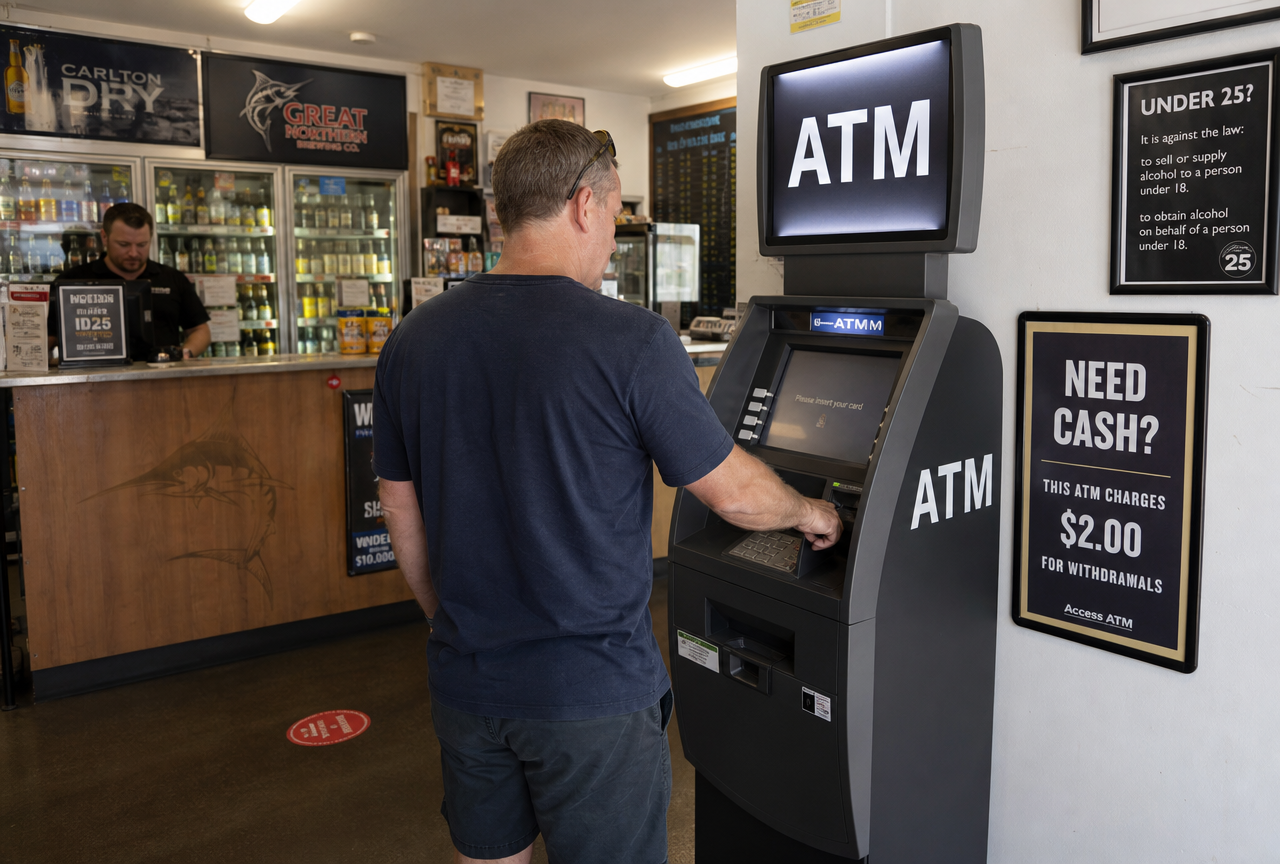
An ATM in line of sight of the counter
Under free ATM placement we supply, install, cash-load, monitor and service the machine, the venue pays nothing, and the venue earns a share of every withdrawal at laundromats and 24-hour sites. That is what turns a cash price on a sign into cash in the till.
Government / official source: Reserve Bank of Australia
General information only, summarised from the official source above on 9 September 2026. Not financial, legal or taxation advice — verify the detail with the source document before acting.
Practicalities
A cash offer only works if customers can get cash
The failure we see most often is a cash price advertised in a venue where the nearest ATM is a block away. The customer wants the discount, has no notes, and pays by card anyway. Cash access on site is what converts the offer into behaviour, and it also keeps spend inside the venue instead of sending it to the shop next door.
- An ATM inside the venue, in line of sight of the counter where the offer is displayed
- Signage at the point of decision as well as at the register
- One sentence staff can say when a customer reaches for a card
- A float and change plan for the extra cash volume across your busiest trading periods
- The discount level written down, so it is applied the same way on every shift
Under free ATM placement the machine, cash float, connectivity, monitoring and servicing are funded by us. The venue pays nothing and earns a share of every withdrawal, so the cash side of your takings becomes income rather than expense. For laundromats and 24-hour sites, that pairing is the practical version of the RBA's own point about steering customers to other payment methods.
Enquire
Get an ATM for your laundromats and 24-hour site
Tell us your business type, trading hours and rough weekly foot traffic, and we will tell you what your site would earn.
What happens after you hit send
- 1You get an instant email confirming we've received your enquiry.
- 2We check your venue type, hours and foot traffic against the right ATM option.
- 3You get a call or email with a clear recommendation and pricing — your choice which.
Reply within 3 business hours
A real person reviews every enquiry. Mon–Fri 8:30am – 7:30pm AEST · Online enquiries 24/7, most venues hear back the same morning or afternoon.
Your details stay private
Sent over an encrypted connection, stored securely, and never sold or shared with third-party marketers.
No obligation, no pressure
You get honest advice on whether free placement, a lease or buying suits your site — walk away any time.
Prefer to talk it through first? Call 0412 025 552
FAQ
Discount for cash — laundromats and 24-hour sites questions
Yes. The Reserve Bank of Australia states that businesses can continue to offer discounts for particular payment methods, and that removing its prohibition on "no-surcharge" rules is not intended to prevent discounts being offered to consumers for using certain payment methods. The rules are national, so laundromats and 24-hour sites are treated the same way as any other Australian business. Confirm your own pricing displays with your payment service provider and the ACCC guidance the RBA refers businesses to.
Card surcharging is being removed. The RBA's March 2026 Conclusions Paper confirmed the Payments System Board decided to lift the prohibition on no-surcharge rules for eftpos, Mastercard and Visa, and the card networks have said they intend to introduce no-surcharge rules from 1 October 2026. If you currently recover card costs with a surcharge, that recovery stops and a discount for cash becomes the main pricing lever you have.
No larger than the card acceptance cost you avoid. With small baskets, a flat cents-per-sale discount is easier to control than a percentage: if card sales cost you an average of 30 cents each, a 20 cent cash discount still leaves you ahead on every cash sale. Work the number out from your own merchant statement, not an advertised headline rate.
In practice, yes. A cash discount only changes behaviour if the customer has notes in hand at the counter. Where the nearest ATM is a block away, most customers take the card option anyway. Under free ATM placement we supply, install, cash-load and service the machine at no cost to the venue, and the venue earns a share of every withdrawal.
No. A cash discount shifts part of your mix to cash; it does not replace card acceptance, and refusing cards costs sales. The practical combination is a competitively priced terminal for card sales plus cash available on site for the discounted price. We will review a recent merchant statement free of charge and show your real cost per card sale.
Two places: at the point of decision, where the customer is choosing what to buy, and at the register, where they choose how to pay. Keep the wording to one line, give staff a single sentence to say, and write the discount level down so it is applied identically on every shift.
No. This page is general information only, summarised from publicly available Reserve Bank of Australia material and reviewed on 9 September 2026. Verify the detail with the original source document, your payment service provider and your own adviser before changing your pricing.
Price your cash discount against your real card costs
Send a recent merchant statement and we will work out your cost per card sale, then show what an ATM on site would add. Phone 0412 025 552, Mon–Fri 8:30am – 7:30pm AEST.
Explore next
Related pages
- Offering a discount for cashThe national explainer, with every RBA source in one place.
- Discount for cash — all states, cities and tradesEvery state, city, regional town and business type in this cluster.
- RBA card payment fee changesDated log of each announcement, with the original source.
- Free ATM placementCash on site at no cost to the venue.
- EFTPOS surcharge rulesWhat changes for card surcharging and when.
- How ATMcash worksOur model, our fees and what a venue earns.
Disclaimer: general information only, summarised from publicly available Reserve Bank of Australia material and reviewed on 9 September 2026. Not financial, legal or taxation advice, and not a substitute for the original source documents. The RBA directs businesses to consult their payment service provider and the ACCC guidance on appropriate pricing displays, and card network rules may change. ATMcash Australia accepts no liability for decisions made in reliance on this page.